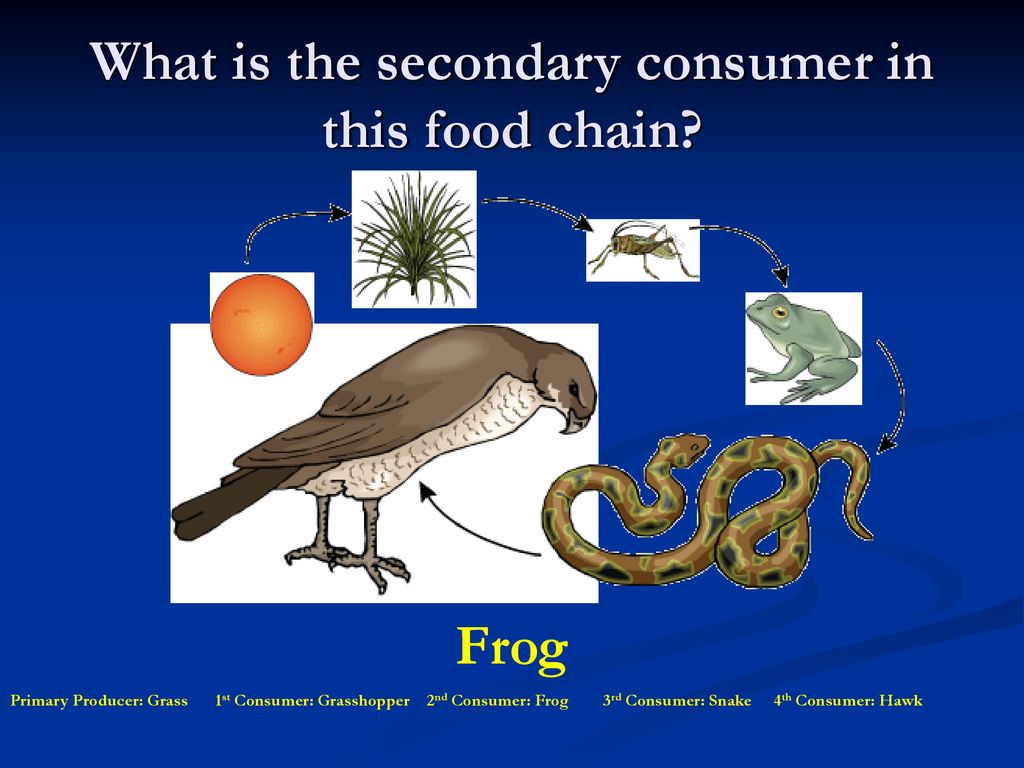
Secondary Consumer Biology Diagrams Secondary consumers are an important part of the food chain. They control the population of primary consumers by eating them for energy. Secondary consumers also provide energy to the tertiary consumers that hunt them. Scientists keep track of the energy movement through consumers by grouping them into tropic levels. Food chains are linear models that illustrate energy transfer from producers to top consumers. Each organism in a food chain contributes to ecosystem balance. Secondary Consumers (3rd Trophic Level): These carnivores and omnivores, such as frogs, small mammals, and birds, feed on primary consumers. Secondary consumers play a role in
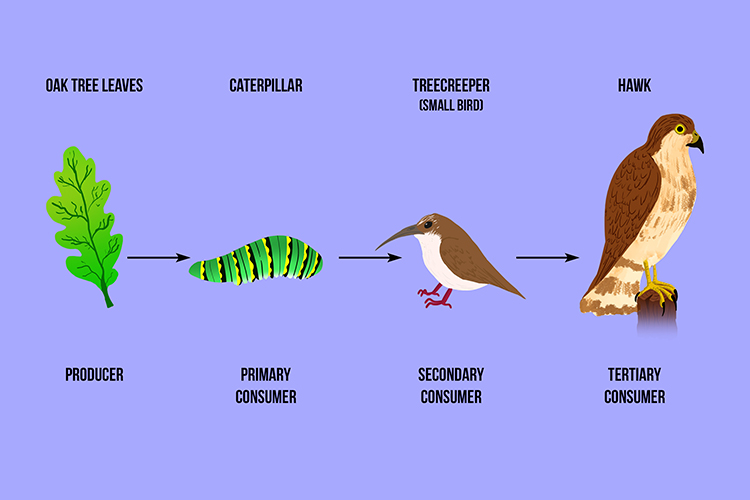
Secondary consumers occupy the third trophic level in a typical food chain.They are organisms that feed on primary consumers for nutrients and energy. While primary consumers are always herbivores; organisms that only feed on autotrophic plants, secondary consumers can be carnivores or omnivores. Carnivores eat only animals, but omnivores eat both animals and plants.
.jpg)
Definition, Examples, Types Biology Diagrams
Secondary Consumers in the Tropic Pyramid. Secondary consumers play a crucial role in the trophic pyramid. The trophic pyramid is a visual representation of the distribution of energy and biomass and consists of different trophic levels, with each level representing a step in the food chain. Secondary consumers are placed at the third trophic level in the food chain. These are organisms that eat primary consumers for nutrients & energy purposes. It shows the flow of energy from one trophic level to another. A trophic level is a feeding level in a food chain. Secondary Consumers Types. Three main types of consumers can be found A secondary consumer is an animal that is primarily a carnivore (carnivores are animals that eat flesh) that preys on primary consumers or herbivores.Other examples of secondary consumers are omnivores (omnivores consume both plant and animal matter) that eat both primary consumers and primary producers or autotrophs.In the food chain, the secondary consumers occupy the third trophic level.
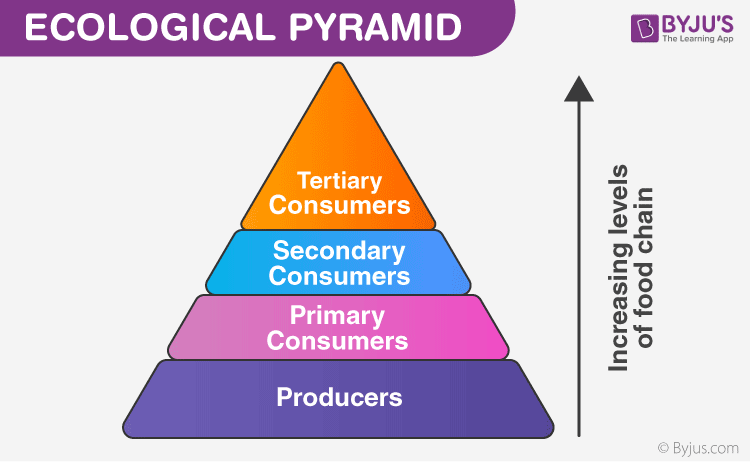
Secondary consumers often serve as prey for tertiary consumers, thus linking various levels of the food chain and promoting nutrient cycling. Role in Ecosystem Resilience In a healthy ecosystem, secondary consumers contribute to its resilience by preventing any single species from dominating the landscape. What are Secondary Consumers? Secondary consumers play a crucial role in ecological systems, serving as a key link in the energy transfer process within a food chain. These organisms primarily obtain their energy and nutrients by feeding on primary consumers, which are typically herbivores that consume plants.The position of secondary consumers is at the third level in a food chain's trophic